Siren Song

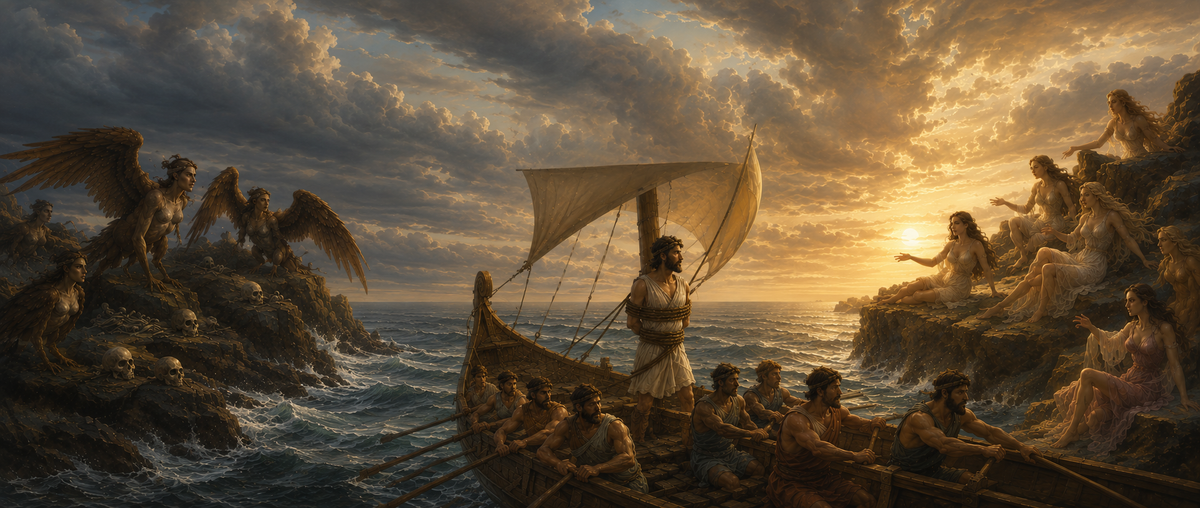
The entire driving force of the Odyssey is a Greek concept called nostos (the longing to return home). Odysseus is a married man who has been away from his wife, Penelope, and his son, Telemachus, for a decade fighting the Trojan War, and he spends another decade trying to get back to them.
Because his ultimate goal is returning to his marital bed and his family, every single obstacle he faces is a threat to his marriage. Giving in to the Sirens means the ship crashes, he dies, and he never returns to his wife. In a metaphorical sense, succumbing to the temptation of another woman destroys the home he is trying to protect.
If you read the actual song the Sirens sing to Odysseus, they don't tempt him with physical intimacy. They tempt him with flattery and validation.
They sing: "Come closer, famous Odysseus—Achaea's pride and glory... we know all the pains that the Greeks and Trojans once endured... we know all that comes to pass on the fertile earth."
In the context of enticing a married man, this is a brilliant psychological metaphor. The temptation isn't always just physical; it is often rooted in ego. The Sirens make Odysseus feel seen, important, and legendary. They promise to listen to his war stories and offer him total understanding. For a weary, traumatized soldier trying to get home, the offer of a woman who just wants to sit and tell him how amazing he is proves to be an almost unbreakable trap.
Odysseus is famous for his hubris (pride). Instead of just plugging his own ears with beeswax like he does for his crew, he orders his men to tie him to the ship’s mast so he can listen to the Sirens' song without being able to jump overboard.
This perfectly mirrors the metaphor of a man playing with fire. Odysseus believes he is strong enough to experience the temptation of these enticing women without actually suffering the consequences. Of course, once he hears them, he loses his mind and begs his men to untie him so he can go to them. He only survives because he is physically restrained. The metaphor is clear: no one is immune to the song once they let themselves listen.
In classical mythology, Sirens were monstrous bird-women (they had the bodies of birds and the heads of women). They were completely grotesque. Their weapon wasn't their physical bodies; it was their divine voices and their promise of absolute, omniscient knowledge.
As centuries passed, artists, Victorian painters, and early Hollywood directors found it difficult to visually convey the abstract concept of "temptation by knowledge." It was much easier (and sold better) to portray temptation as a beautiful, seductive woman. Over time, the Sirens were visually merged with mermaids and water-nymphs, shifting the metaphor from an intellectual temptation to a purely sexual one.
Even though Homer didn't write them as attractive human girls, the modern metaphor survives because the core psychology remains true: the Sirens represent the ultimate, deadly distraction that flatters a man's ego and begs him to abandon his journey home.