Oil & Bitcoin

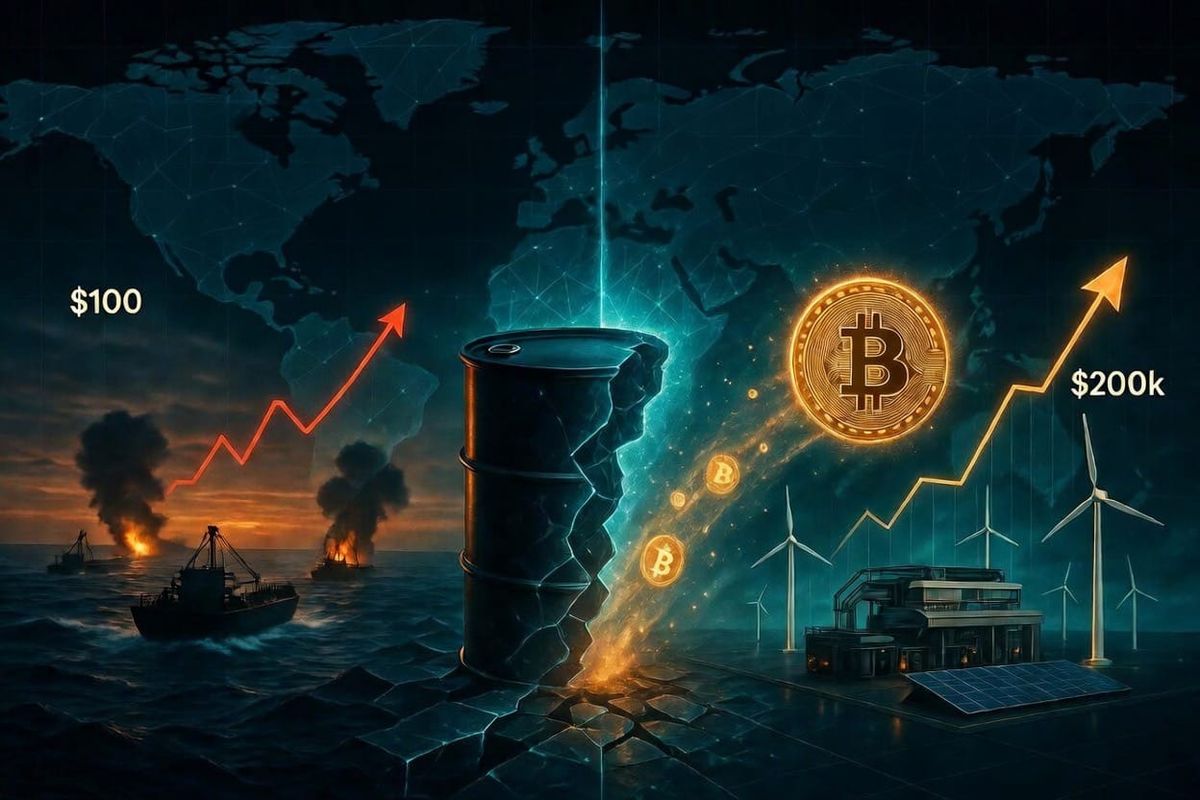
The conflict in Iran has fundamentally reshaped the global energy and digital-asset landscapes, unleashing a dual shock whose effects will echo through the end of the decade. As of late March 2026, Brent crude has surged past the $100-per-barrel threshold amid maritime disruptions in the Strait of Hormuz and precision strikes on key infrastructure. Roughly one-fifth of the world’s oil supply stands under immediate threat, injecting a genuine war premium into prices that could climb briefly toward $120. Yet this spike, while painful in the short run, carries the seeds of its own reversal. Science-based forecasts from the International Energy Agency and similar models indicate that the high-cost environment will accelerate demand destruction. By 2028, energy insecurity will have driven a tipping point in electric-vehicle adoption and renewable-grid integration. As a result, global oil demand is projected to peak and begin a sustained decline, anchoring prices in a structural range of $75 to $85 per barrel by 2030.
Bitcoin’s path through the same period follows an entirely different set of scientific and structural rhythms, centered on its four-year halving cycle and its deepening ties to global liquidity. In the immediate wake of the 2026 conflict, the asset has behaved like the high-beta risk instrument it remains, swinging sharply as capital first fled toward the safety of the U.S. dollar. Elevated oil prices have pushed central banks to hold interest rates higher for longer, creating the classic headwind for digital assets. But the 2028 halving will cut new daily Bitcoin issuance in half once again, from 3.125 to 1.5625 coins per block. That supply shock, layered atop steady institutional inflows through exchange-traded funds, is expected to decouple Bitcoin from short-term geopolitical turbulence. Established predictive frameworks, including power-law correlations and refined stock-to-flow variants, point to a new valuation regime. By 2030, Bitcoin is forecast to stabilize between $180,000 and $240,000, solidifying its role as a primary hedge against the currency debasement required to finance prolonged regional instability.
The true significance of the Iran conflict lies in the way it has fused these two markets. At the outset, soaring electricity costs tied to oil and natural gas squeezed mining margins, lifting break-even levels above $100,000 per coin for many U.S. operators. The pressure triggered an accelerated migration of global hash rate toward regions rich in low-cost energy and behind-the-meter renewable projects. Over the next four years, that migration will complete a profound transition: Bitcoin mining will evolve from a fossil-fuel-dependent activity into a stabilizing force for renewable grids, absorbing stranded energy that would otherwise be wasted. By 2030 the network will have grown far more resilient to the very oil-price shocks that defined 2026.
The convergence of the April 2028 halving and the projected cooling of the oil market creates a rare macroeconomic scissors effect. As war-driven premiums fade and oil settles near $95 per barrel in 2028, the primary operating cost for the Bitcoin network will finally detach from volatile energy markets. At the precise moment when miner revenue is halved in Bitcoin terms, the global energy baseload will become cheaper. Meanwhile, the earlier oil spike will have already forced high-cost miners to upgrade equipment or relocate to more efficient regions. The surviving network will therefore enter the halving era as the most resilient and energy-optimized in its history. Hash rate and security will remain at record levels even as new-coin issuance reaches its lowest point yet.
From a policy perspective, the cooling of oil prices in 2027 and early 2028 is expected to ease headline inflation that had been inflated by transportation and manufacturing costs during the conflict years. That disinflation will give central banks, led by the Federal Reserve, the political and economic cover to pivot toward lower interest rates. Because Bitcoin has historically shown a strong inverse relationship with real rates, the return of a cheap-money environment will coincide perfectly with the halving’s supply shock, setting the stage for a powerful price advance.
In the end, 2028 may be remembered as the year the energy-monetary loop finally closed. The retreat of oil prices will mark the beginning of the end for the old world’s dependence on geographically concentrated, geopolitically fragile fossil fuels. The halving, occurring in the same window, will mark the maturation of a globally distributed, digitally scarce alternative. By 2030, the high-liquidity conditions born from the 2028 rate cuts will have redirected capital flows that once enriched Middle Eastern oil producers into the ecosystems that support Bitcoin and the renewable grid it helps stabilize. What began as a destructive regional conflict will have become, paradoxically, the catalyst that hastened the transition from physical scarcity to digital resilience.