In Math We Trust

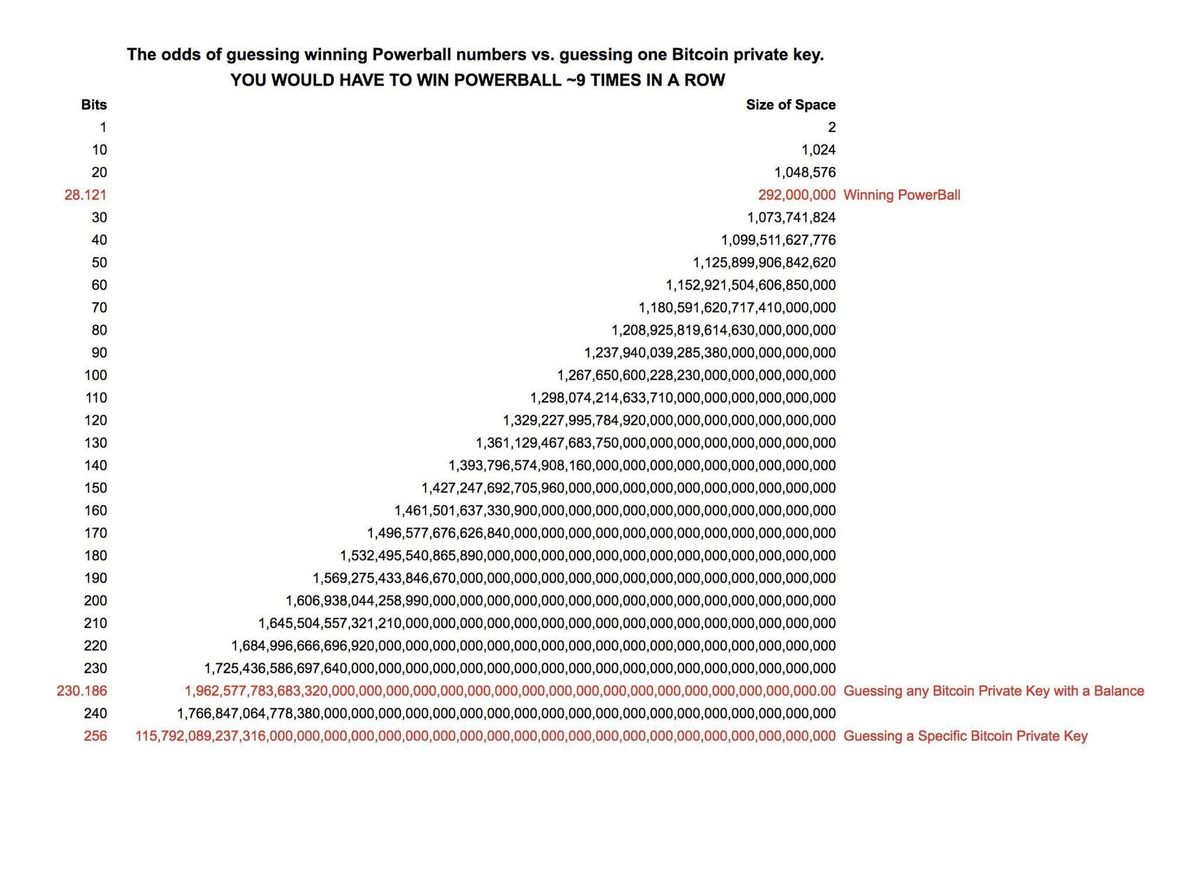
The security of a Bitcoin wallet relies entirely on the mathematics of very large numbers. A wallet is not a digital file stored in a vault, but simply a secret number, known as a private key, which allows you to move funds. The reason no one can steal your funds is that the range of possible numbers is so vast that guessing yours is statistically impossible.
To understand the scale of this security, we can compare it to the Powerball lottery. The odds of winning the Powerball jackpot are roughly one in 292 million. In the language of computers and cryptography, this level of difficulty is represented by about 28 bits of data. It is a rare event that almost no one experiences.
A Bitcoin private key, however, is a number made of 256 bits. Because the size of the number space doubles with every single bit added, the gap between 28 bits and 256 bits is not merely a few times larger. It is exponentially larger. The number of possible Bitcoin keys is a figure with nearly 78 digits.
If you wanted to guess a specific Bitcoin private key by pure chance, you would need to defy probability on a cosmic scale. The mathematical difficulty is roughly equivalent to winning the Powerball jackpot nine times in a row. This is not just unlikely; it is effectively impossible within the timeframe of our universe.
Even if a thief tried to guess any private key that currently holds a balance, rather than a specific one, the task remains futile. While there are millions of funded wallets, finding one among the near-infinite ocean of empty wallets is still a task requiring about 230 bits of effort. This is akin to finding a single specific atom in a galaxy.
This wall of numbers is what makes Bitcoin secure without a bank or administrator. The system does not need to lock your account because the universe of possible keys is simply too large to be searched. Your money is safe because the math makes it unfindable. In math we trust.