Light Speed Shift

Why Photonics are Reimagining the Future of Computing
The long-standing reign of silicon and electricity is facing its most significant challenge yet. For decades, we have shrunk transistors to squeeze more performance out of electrons, but we have finally hit the physical limits of heat and frequency. As we approach 2026, the conversation in the world’s preeminent scientific journals, such as Nature and Science, has shifted toward a radical alternative: computing with light. Recent breakthroughs, particularly from researchers at Tsinghua University and various Chinese tech leaders, have demonstrated that photonic chips are not just a faster version of what we have today, but a fundamental departure from how we process information. By utilizing the unique properties of photons, these new systems are achieving speeds and efficiencies that make traditional electricity look like a relic of the past.
At the heart of this revolution is the staggering frequency at which light operates. While modern electronic processors struggle to maintain stability above 5 gigahertz due to resistive heating, light waves oscillate at frequencies approaching 100 terahertz. This is a leap of four orders of magnitude. Because photons lack mass and charge, they do not generate the same kind of heat when traveling through a medium. This allows for a massive increase in bandwidth, enabling data to be modulated and processed at rates that were previously thought to be impossible. Recent papers have showcased "ultra-parallel" photonic chips that can handle over 100 separate wavelengths of light simultaneously, effectively turning a single chip into a massive multi-lane highway for data.
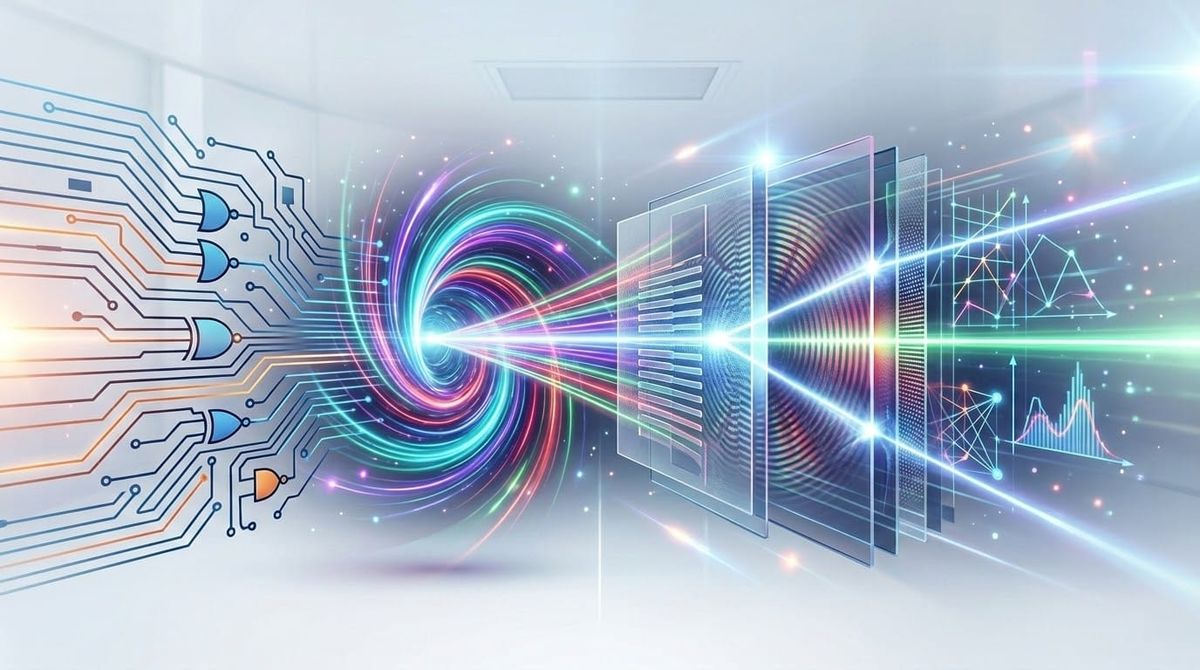
One of the most remarkable aspects of this new era is the move toward three-dimensional matrix multiplication. In a traditional computer, a matrix multiplication—the core math behind every AI model—is a sequential process of moving numbers in and out of memory. However, chips like the Taichi photonic architecture utilize the physical behavior of light to perform these calculations in 3D space. By shining a beam of light through layers of diffractive masks or interference patterns, the "math" happens as the light travels. This is known as a Diffractive Optical Neural Network. Each layer of the chip acts as a set of weights in a neural network, and as the light passes through, it is filtered, bent, and combined to produce an output. The result is a system that can process billions of parameters in the time it takes for a laser pulse to traverse a few millimeters of hardware.
The most profound claim emerging from these studies is that photonic matrix multiplication can achieve O(1) time complexity. In computer science, O(1) denotes a process that takes the same amount of time regardless of how large the input is. For a standard GPU, a larger matrix means more cycles and more time. But in an all-optical system, the time it takes for light to pass through the processing layers is constant. Whether you are multiplying a 10 x 10 matrix or a 10,000 x 10,000 matrix, the "calculation" is finished at the speed of light the moment the beam hits the detector. This constant-time processing removes the scaling bottleneck that currently limits the training of massive foundation models, potentially allowing for AI architectures that are thousands of times larger than those currently in existence without a corresponding increase in latency.
As these technologies move from the laboratory to the data center, the role of electricity is being relegated to a support function. In the current paradigm, we experience a massive energy loss during the conversion from optical signals in fiber optic cables to electrical signals for the processor, and then back again. This "optical-electrical-optical" bottleneck is responsible for a huge portion of the power consumption in modern global computer infrastructure. The goal of current photonic research is to stay in the "light domain" for as long as possible, using electricity only to power the initial laser and the final sensors. If this trend continues, we may soon reach a point where electricity is indeed the "odd man out," used merely to keep the lights on while the actual thinking happens at the speed of light itself.