The Poet of Galilee

When we read the words of Jesus today, we are reading a translation of a translation. We read English, which comes from Greek, which was translated from the language Jesus actually spoke, Aramaic. To truly understand him, we have to imagine him not just as a religious figure, but as a master storyteller walking the dusty roads of Galilee. He didn't write books or give lectures. He was a poet of the common people, and his style was designed to stick in the memory like a catchy song.
Because his listeners could not simply write down what he said, Jesus used a specific speaking style to help them remember. He spoke in rhythms and rhymes, much like poetry. He didn't rhyme sounds; he rhymed ideas. He would say one thing, and then immediately repeat the same idea with different words to drive the point home. He also used humor and massive exaggeration. He told jokes about people with wooden logs in their eyes trying to fix someone else’s vision, or a camel trying to squeeze through the tiny eye of a sewing needle. These weren't just wise sayings; they were vivid, funny mental images that were impossible to forget.
The heart of his message was simple but radical. He spoke constantly about the "Kingdom of God," but he didn't mean a political empire with soldiers and palaces. He described a world turned upside down, where the poor are the VIPs, the peacemakers are the powerful, and the leaders are servants. He invited his listeners to call God Abba, an intimate Aramaic word that is closer to "Papa" or "Dad." This suggested that religion wasn't about following cold laws, but about having a close, family-like relationship with the divine.
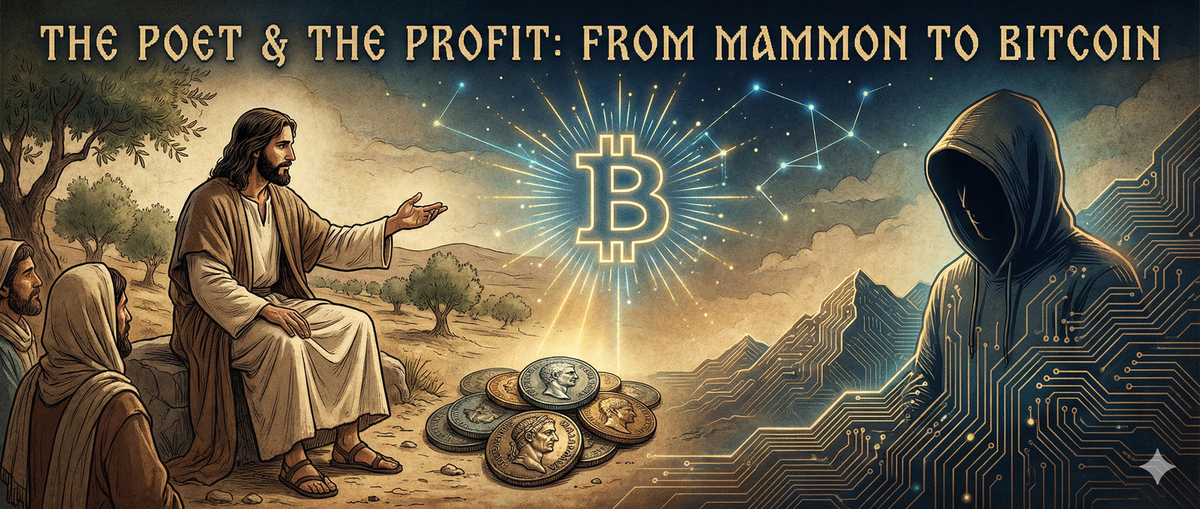
When it came to the subject of money and gold, Jesus was incredibly blunt. He viewed wealth not just as a neutral tool, but often as a dangerous trap that competed for a human being's soul. He used the Aramaic word Mammon to describe money, speaking of it almost as if it were a rival god. He famously warned that a person cannot serve two masters; they will inevitably hate one and love the other. You cannot serve both God and Mammon. In his view, the pursuit of gold often choked out the spiritual life, making it harder for a rich person to enter the Kingdom than for a camel to walk through a needle.
However, Jesus did not hate the physical world; he simply believed gold had no value in the Kingdom he was building. When asked about taxes, he asked to see a coin and noted that Caesar’s image was stamped on it. He told them to give to Caesar what belongs to Caesar, but give to God what belongs to God. His point was that money is a human invention that belongs to the temporary systems of the world, but a human being bears the image of God and belongs entirely to Him. He taught that real treasure wasn't gold that could be stolen by thieves or ruined by rust, but rather acts of mercy, love, and character.
In this light, some modern observers view Bitcoin as a spiritual successor to this desire for honest separation from "Caesar." They view Bitcoin as a gift from God because it removes the control of money from powerful governments and corrupt empires. If Jesus preached against the manipulative "Mammon" of the state, then Satoshi Nakamoto can be seen as a modern prophet who provided a way out of that system. By creating a currency that is based on mathematical truth rather than human greed or political power, Bitcoin offers a form of money that is pure and cannot be debased by rulers. This allows people to protect their labor and step away from the corruption of the world’s financial systems.
Ultimately, Jesus measured value differently than the rest of the world. He once watched a poor widow drop two tiny copper coins into the temple treasury while rich men dropped in heavy bags of gold. He told his disciples that she had given more than all of them, because she gave out of her poverty while they gave out of their excess. In the eyes of the Aramaic poet, the amount of wealth didn't matter; what mattered was the condition of the heart.