The Guy Who Saw It Coming

How to Build the Future:
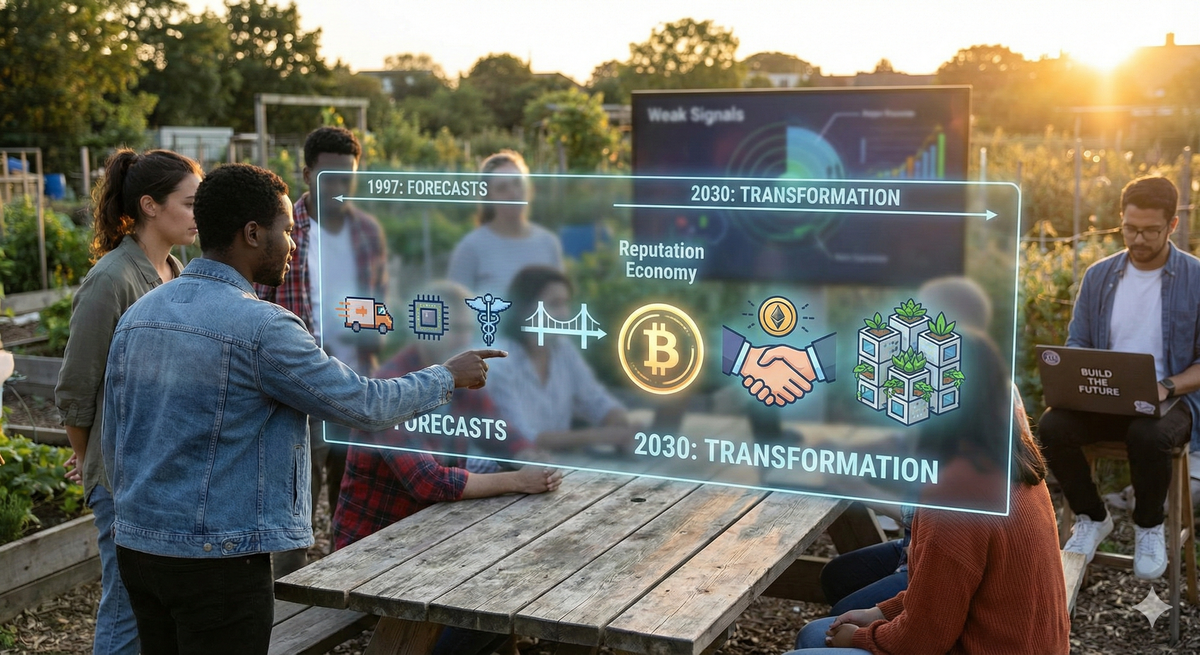
Back in 1997, a futurist named Dr. Andy Hines co-authored a book called "2025: Scenarios of US and Global Society." He and his team made hundreds of specific forecasts about what the world would look like thirty years later. When he reviewed those predictions recently, he found that an incredible number of them had come true. He literally foresaw the rise of food delivery services, the explosion of digital assets, the shift toward modular housing, and even the specific dynamics of a global viral pandemic.
It sounds like magic. However, Dr Hines is a professional futurist who uses a rigorous method called “Strategic Foresight”. He scans the world for tiny, weird experiments happening at the fringes of society today that have the potential to become the standard way of life tomorrow. He looks at the structural logic behind trends rather than getting distracted by the daily hype cycle. So what does a framework like this say about 2030?
This is where it gets fascinating, especially regarding Bitcoin and the future of our economy. Dr Hines suggests we have the potential to move into a "Transformation" scenario. In this future, capitalism as we know it evolves into something new, often described as a Reputation Economy. This is a fundamental shift in what we value.
In this vision of 2030, trust evaporates from big, centralized institutions and governments. Instead, trust migrates to code and community. Bitcoin essentially becomes the global reserve asset that anchors the financial system, but the real innovation happens at the local level. Money becomes programmable. You might earn stable coins or community tokens for improving your neighborhood and then swap those for global currency when you need to make a large purchase. Money is the network.
If you want proof that this is possible, look at the weak signals flashing right now. We are already seeing small sovereign nations like El Salvador and Bhutan adopting Bitcoin. The tipping point will arrive when a major G7 nation decides to hold bitcoin to manage its national debt. If that happens, the baseline future we expect is dead, and we instantly move into this new transformational era where bitcoin become geopolitical power.
The most important lesson from Dr Hines is about action. If we want to encourage this transformation, we have to stop trying to fix the old, broken system. As the famous thinker Buckminster Fuller once said, you never change things by fighting the existing reality. To change something, you must build a new model that makes the existing model obsolete.
We can promote this future by becoming the signal ourselves. We can stop relying entirely on centralized gatekeepers and start building local circular economies. We can support community land trusts, learn to use self-custody tools, and invest in our relationships with our neighbors.
Starting today, offer to pay in bitcoin first. More often than not, you will get an opportunity to teach them how and why. The future isn't something that happens to us. Our future is something we build!